Outsourcing has to be one of the simplest and most efficient aspects of running a business. Still, the slightest wrong choice can end up draining your time, team morale, and trust. If outsourcing is freeing your people to focus on work that actually contributes to your business’ growth, you are doing outsourcing right. This starts with selecting an outsourcing company that you find reliable.
This single decision greatly impacts how your operations run, how you handle risks, and how confidently you scale. This blog will cover these topics:
- How you should choose an outsourcing company
- What are some of the tried-and-tested key outsourcing company selection criteria
- Which risks, benefits, and evaluation factors you should prepare for when outsourcing tasks
- A practical outsourcing company checklist
- When it makes the most sense for your company to outsource
What Does Selecting an Outsourcing Company Really Mean?
Selecting an outsourcing company means you make the conscious effort of picking a service provider who’s offering exactly the functions you are looking to delegate. But this isn’t as easy as just randomly choosing either the cheapest option or the one you find the quickest to reply. Instead, you should consider how the outsourcing provider will actually handle certain functions of your business and represent your brand with an external staff.
There are two ways to approach this: short term and long term. Transactional outsourcing focuses on short-term tasks. Long-term outsourcing, on the other hand, focuses on outcomes, accountability, and continuity. The latter also compels you to ask some of the harder questions, such as:
- Will this partner grow with you?
- Do they understand your industry?
- Can they operate within your rules, not just theirs?
Payroll, HR, IT, customer support, and finance all demand different levels of control and expertise. Thus, different types of business outsourcing are suited to different functions.
Why Businesses Choose Outsourcing in the First Place
So what makes businesses choose outsourcing in the first place? That’s because you can make outsourcing your best strategy when you have set clear goals. Rushing it though only turns it into a recurring problem. That’s why we are emphasizing how your choice and criteria have a long term impact.
Most companies outsource because of particular demands. It could be speed, the goal of accessing skills that are harder to have in-house, or it could be for giving their internal teams some room to focus on business strategy instead of administrative tasks.
The benefits of outsourcing services are most evident in how execution improves without adding management overhead. You gain flexibility, consistent delivery, and specialist support without expanding headcount. That is why many leaders see the benefits of business outsourcing as a way to strengthen operations along with reducing internal load.
Key Factors to Consider When Selecting an Outsourcing Company
When you are selecting an outsourcing company, you need to be able to separate reliable partners from risky ones. Having a clear outsourcing company selection criteria that prioritizes flexibility, transparency, and the ability to adapt without disruption will help you with that. These are the factors you should consider when outsourcing:
Expertise, experience, and industry knowledge
Consider what the provider has actually done rather than what they promise. Relevant experience matters more than years in business. Ask them these questions to gather if they have the expertise, experience, and industry knowledge you are looking for:
- How do they handle cases similar to yours?
- Which industries do they serve most?
- How do they solve problems when things go sideways?
If you are running a local business, you should know how to assess UAE outsourcing expertise. Local laws, reporting expectations, and business norms affect daily operations. A provider who knows the region saves you from hassles that aren’t inevitable.
Compliance, data security, and legal readiness
Outsourcing does not remove responsibility. What it does is it shifts execution. You still own compliance. That is why contracts, confidentiality terms, and data handling processes matter from day one.
Clear alignment with UAE outsourcing contract requirements protects both sides. Look for providers who explain their approach plainly and answer questions without sidesteeping or skipping any important details. If they treat compliance as an afterthought, you should treat that as a warning.
Cultural compatibility and communication
Culture affects delivery more than most people expect. Response times, escalation styles, and decision making all reflect how a provider works internally.
Cultural considerations in UAE outsourcing are especially important when teams span regions. Shared expectations, respect for timelines, and clear communication rhythms reduce misunderstandings and keep work moving without constant follow ups.
Scalability, technology, and service flexibility
Your business will change. Your outsourcing partner should be ready for that. Ask them how they adjust these as volume grows:
- scale teams
- service scope
- report performance
Outsourcing Risks and Considerations Businesses Often Overlook
Some outsourcing risks and considerations only surface after onboarding. Most of the issues that make themselves known later are:
- Hidden charges
- Unclear responsibilities
- Quality gaps
These often stem from vague agreements or rushed decisions. Over time, this can create dependency on a provider who is hard to replace. Poor outsourcing partner selection also exposes businesses to compliance and continuity risks.
When processes live outside your walls, you need confidence that controls are strong and documented. You reduce risk by taking following actions:
- setting expectations early
- defining ownership clearly
- reviewing performance regularly
How to Choose the Right Outsourcing Provider: A Practical Checklist
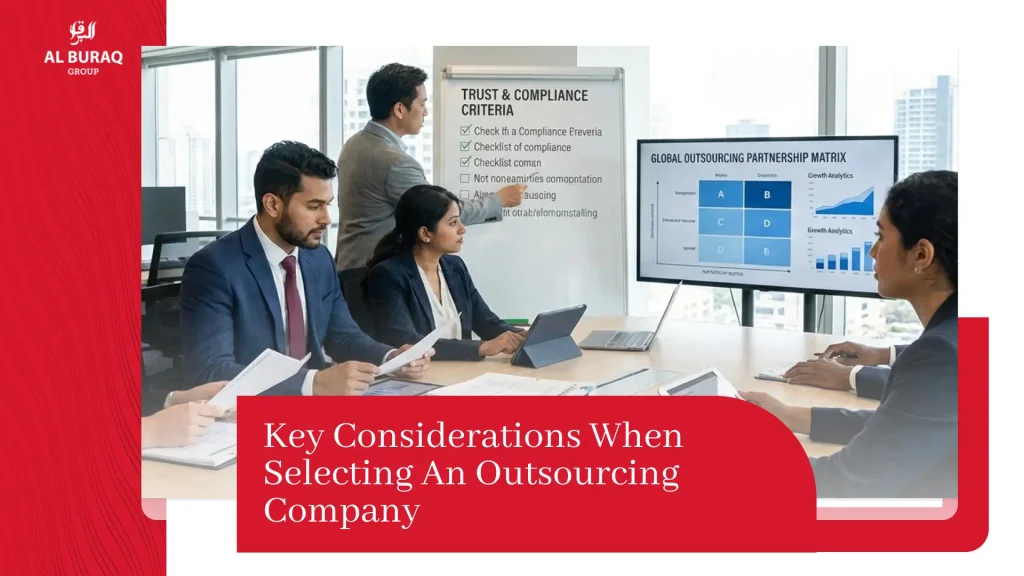
Use this outsourcing company checklist for choosing the right outsourcing provider:
- Confirm alignment between your business goals and the services offered
- Look for proven experience with references you can verify
- Review compliance readiness, security standards, and reporting processes
- Make sure pricing structures are transparent and service levels are defined
- Discuss exit plans upfront so continuity is protected if things change
It will help you with the process of how to choose an outsourcing company.
Selecting an Outsourcing Company for Payroll and HR Functions
When you are selecting an outsourcing company for payroll, ask them how they manage these:
- compliance updates
- protect employee information
- handle exceptions
Reliable service providers specializing in payroll outsourcing guide you by answering your questions and helping you spot potential gaps before those turn into bigger issues.
Payroll and HR are among the most commonly outsourced functions because they demand accuracy, confidentiality, and constant updates. Errors here damage trust fast.
Payroll outsourcing advantages include:
- consistent processing
- timely reporting
- reduced internal admin load
But this is only applicable when the provider understands local rules and responsibly handles data.
Outsourcing in the UAE: What Businesses Should Know
Businesses should know this if they are considering outsourcing core tasks in UAE:
Regional context matters a lot. That’s why outsourcing services in UAE operate within a specific legal and cultural environment. Employment laws, reporting standards, and business etiquette influence how services are delivered.
Work with providers familiar with the region to reduce onboarding time and compliance exposure. While many businesses look for the best outsourcing companies in the UAE, the right fit matters more than reputation alone.
Focus on how the provider supports your operational needs locally, communicates with stakeholders, and adapts to regulatory expectations without constant escalation.
When Outsourcing Makes Sense & When It Does Not
Selecting an outsourcing company works best when it supports your strategy, not when it replaces one.
Outsourcing works best when processes are defined and outcomes are clear. It delivers strong returns when internal teams are stretched or when specialist skills are needed quickly.
It may not be the right move if requirements change daily or if knowledge must stay tightly controlled in house. Being honest about readiness helps you avoid forcing outsourcing into places where it does not belong.
Final Thoughts: Making the Right Outsourcing Decision
Selecting an outsourcing company is a significant strategy which affects how your business will operate in the long run. The right outsourcing partner will strengthen delivery, reduce risks, and give your team enough room to focus on growth and expansions.
You can easily turn outsourcing into a competitive advantage using a structured approach grounded in real selection criteria and a clear checklist. Choose with intent, review with discipline, and treat your outsourcing partner as an extension of your business. If you want to see the positive impact of outsourcing first hand, get in touch with us for our services.
FAQs
What are the most important factors when selecting an outsourcing company?
The most important factors when you are selecting an outsourcing company include relevant experience, compliance readiness, communication style, scalability, and cultural fit.
How do I evaluate outsourcing company selection criteria effectively?
You can effectively evaluate an outsourcing company by reading their client reviews, looking up past references, and asking them scenario-based questions. A great outsourcing company will provide you with clear answers and they will have clearly documented processes.
What are the biggest outsourcing risks businesses should watch for?
The biggest outsourcing risks businesses should watch out for include unclear contracts, weak compliance controls, hidden dependencies, and poor communication.
Is outsourcing suitable for small and mid sized businesses?
Yes, outsourcing is suitable for small and mid sized businesses.
How long does it take to onboard an outsourcing partner?
Onboarding an outsourcing partner takes a different period of time for different companies.